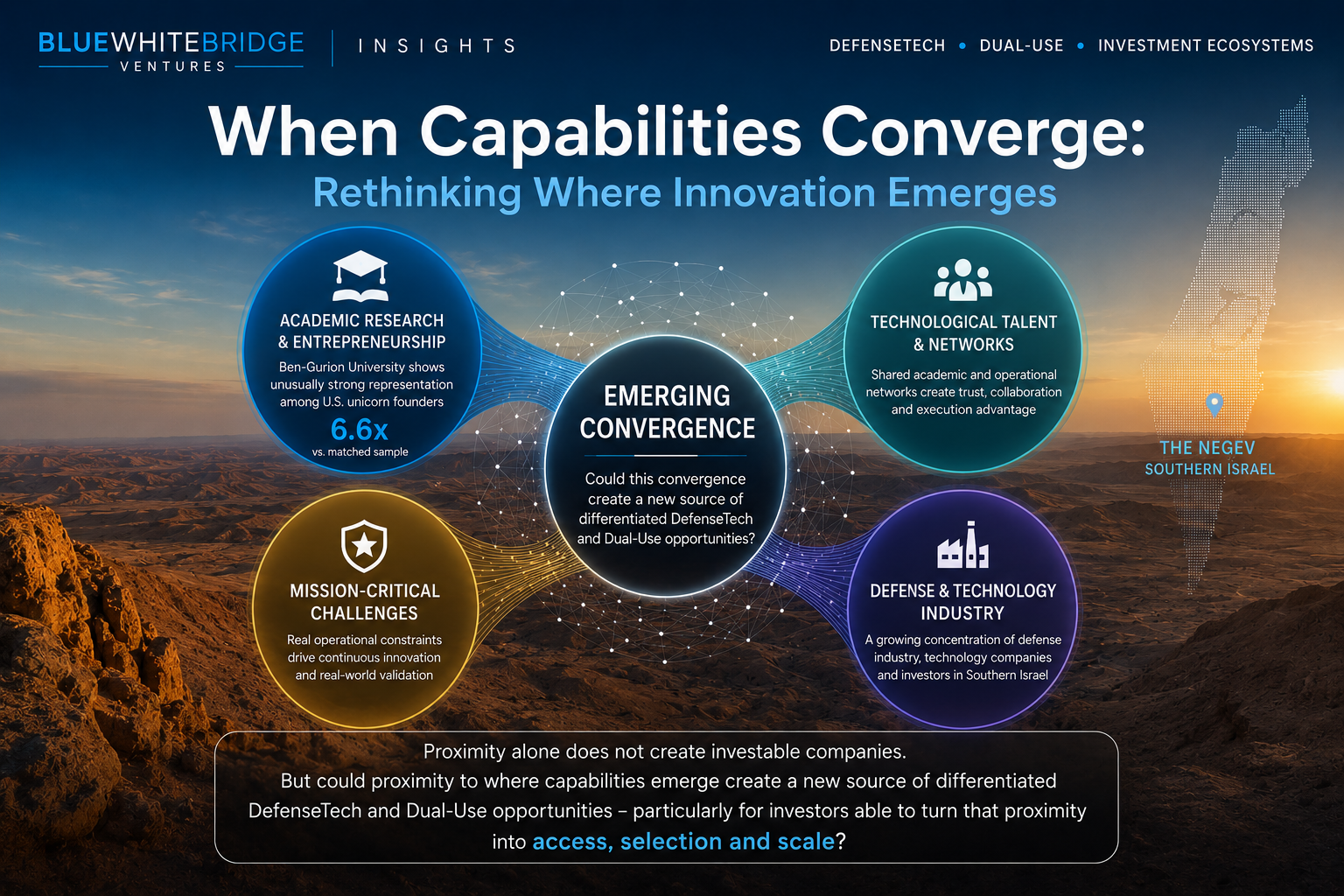
When Capabilities Converge: Rethinking Where Innovation Emerges
Kobi Bar-Shalom
Founder, BlueWhiteBridge Ventures
Can proximity to where capabilities emerge become an investment advantage?
01 | An Intriguing Signal
Which signals actually help investors understand where exceptional companies are more likely to emerge?
I tend to look at data like this from two perspectives: what does it tell us about venture outcomes — and can those signals help us think differently about where to look for future opportunities?
A recent analysis by Stanford GSB Professor Ilya Strebulaev offers a fascinating lens.
One result naturally caught my attention.
Ben-Gurion University — where I conduct research and teach entrepreneurship to engineering students — is located in Israel's southern Negev region, historically far from the country's main concentration of venture capital and startup activity.
Yet its graduates show particularly strong overrepresentation among U.S. unicorn founders relative to a matched sample of VC-backed founders: 6.6×, third among the non-U.S. universities shown.
Rather than treating this as a ranking, I found myself asking a different question: What might sit behind that result — and can it tell us something about where future companies may emerge?
02 | Networks May Be Part of the Answer
Another part of the research offers an important clue.
At leading U.S. institutions such as MIT and Stanford, a meaningful share of unicorn founding teams came from shared academic networks, often involving people who attended during overlapping years.
Networks matter. Shared history matters.
The Israeli context may add another layer.
Having served in Unit 8200, I have seen an environment in which teams work together around difficult, mission-critical operational challenges.
Those environments can create more than technology. They can create relationships, trust, shared problem-solving experience and demonstrated execution capability.
For DefenseTech, this suggests an interesting extension of the academic-network insight: a shared university may matter. But having built together and solved real problems together may create another form of entrepreneurial network.
03 | When Capabilities Begin to Converge
The Negev provides an interesting setting in which to examine what happens when several of these dynamics begin to intersect.
Academic research and entrepreneurship. Technological talent and networks. Mission-critical challenges. Defense and technology industry.
The relocation of major IDF technological capabilities toward the region adds another layer to an existing concentration around Ben-Gurion University, research infrastructure, technology and defense companies and entrepreneurial activity.
And there are increasing signs of deliberate efforts to strengthen the connections between these capabilities.
But convergence itself is not the investment thesis. It creates potential. The investor’s question is what becomes possible because of it.
04 | Validation Is Not Product-Market Fit
This distinction matters particularly in DefenseTech and Dual-Use.
A technology that has performed successfully in a mission-critical environment may have demonstrated technical capability, operational relevance and execution under demanding conditions.
That can reduce meaningful dimensions of technological and operational uncertainty.
But real-world validation is not the same as commercial validation. A defense customer, operational deployment or successful POC does not automatically establish a scalable civilian market, repeatable sales motion or commercial product-market fit.
This creates both a risk — and an opportunity.
The risk is mistaking validation for a company. The opportunity is identifying which validated capabilities can make the transition.
05 | From Proximity to Investment Advantage
This is where the investment process can begin earlier.
Not simply by waiting for companies to enter conventional venture deal flow, but by understanding: What is the underlying operational challenge? What has actually been validated? Is the capability defensible? Can it become a company rather than remain a technology? Where are the broader Dual-Use applications? Who are the potential customers, strategic partners and follow-on investors?
That changes the role of proximity.
"Proximity becomes valuable only when it improves access, selection and scale."
Access — seeing capabilities and teams earlier. Selection — distinguishing technological validation from true investment potential. Scale — helping the strongest companies cross from mission-critical application into larger markets through capital, partnerships and global commercialization.
06 | What This Means for BWB
For BlueWhiteBridge Ventures, the Negev is particularly interesting not as an investment thesis in itself, but as an environment in which our investment thesis may create differentiated access.
Our focus is broader: DefenseTech, Dual-Use and Resilience technologies where mission-critical challenges and real-world validation can reveal capabilities with significantly larger commercial potential.
The opportunity we see is the bridge between those worlds: From challenge to capability. From capability to validation. From validation to investability. From DefenseTech to broader Dual-Use markets. From local capability to global scale.
That is where we believe investment judgment and company-building experience can create value.
07 | From Observation to Action
And this is where the idea becomes practical.
If emerging innovation environments can provide earlier signals of technological capability, investors should not only observe them from a distance. They should build the relationships and evaluation mechanisms that allow the strongest opportunities to be identified, tested and supported earlier.
At BWB, that means continuing to build relationships across founders, industry, academia, mission-critical environments and global capital — while developing a disciplined investment framework for deciding what should cross the bridge and what should not.
Because the objective is not to invest in an ecosystem. It is to find exceptional companies that may emerge from it.
And if you are building, investing in, validating or commercializing technologies at this intersection, we would be interested to compare perspectives.